Wednesday, 24 June 2020

Bletchley Park and codebreaking

Husbands, sons and boyfriends are impossible to buy presents for but I had a brainwave when I was thinking of a present for my husband this year. I decided to get him the Bletchley Park Brainteasers book to challenge him in a different way from his daily work! I don't think he appreciated the challenge as it has been sitting on the coffee table since his birthday in April! So, this week, I decided to have a go at the first problem which is the crossword that secretly tested people in 1942. If they could do it in less than 12 minutes, then they received a letter asking them to join the war effort at Bletchley Park and become a Codebreaker.
So far, I have got about 4 clues correct and taken 3 days....I don't think I am a very good codebreaker!
However, playing word games is fun so I have found some interactive sites where you can try your codebreaking skills in English!
1. gamestolearnenglish.com
This game is for Phrasal Verbs which you probably know make up a huge part of the English vocabulary and are tricky things to learn
An explanation of Phrasal Verbs in French if you happen to be a French speaker:
There are other games on that website too so have a look around.
2. British Council learnenglishteens
A lot of games here need Flash Player but this one worked fine for me without. It was challenging though!
3. Brain Pages
This is generally code-breaking related but as codes and words are related then it's a good place to challenge the language part of your brain!
Can you do this puzzle based on one from the Bletchley Park Brainteasers book?
A king of a land far away was planning a day out in the hills. He wanted to bring some guests and after looking through his contacts list chose his father's brother-in-law, his brother's father-in-law, his father-in-law's brother, and his brother-in-law's father. How many people do you think will join him as a guest?
Post your answers in comments!
And finally, have you seen The Imitation Game?
It is about Bletchley Park and Alan Turing played by actor Benedict Cumberbatch. Watch in the Original Version for some beautiful English accents - there is a link to the trailer below.


Friday, 12 June 2020

Summertime Tutoring

Back to blogging...

I've started to tutor some young French students recently who are between 2nd and 3rd year of their Bachelor degree. After the upheaval of the Confinement in France and the change to all online lessons, there is definitely a great opportunity to keep up the online presence with help and links. In tandem with my teaching resources and a pseudo-blog through school, I have decided to dust off this old blog, rename it and get it going again too.


A film to match the weather today


I actually found it hard to write the word 'summertime' in the title as it has been raining for 9,5 hours as I write and is forecast to rain all next week too. The heating is back on and I'm drinking hot drinks rather than cold ones. So much for the summer...!


However, I guess we need the rain because the fact that this area was already close to drought conditions has been in the news recently. So while we wait for warmer days, it's always a good plan to watch an entertaining movie...


There's a trailer for a film called "A Rainy Day in New York" here. The film has not had top reviews so it may be a "washout" - better to check the reviews first. Still, the long trailer, in itself, is useful for English!


Do you know about Shadow Speaking?

You could also try to Shadow speak while you watch the trailer. You listen to a bit of the audio, practise saying it yourself then go back, play it again and speak along with the person on the audio. That way, your skills in listening will improve - try it with this one!


Vocabulary from the trailer

scoop - an exciting news story or a portion of ice-cream

a squeeze - a girlfriend/boyfriend or a tight fit

imbibe- to drink alcohol

copiously - in large quantities

absurd - ridiculous

funny business - idiom for something that is happening but is not normal

lousy - terrible, rubbish, awful


Thursday, 29 August 2019

The Triune Brain

The TOEFL often features talks with a science theme so today I decided to find one that is also an IELTS Academic theme (in the reading section) because listening to an explanation can often help to explain a Reading exercise that's based on the same subject. Please note, I am not a Psychologist so this is new to me too and only intended as a practice listening!


Photo by jesse orrico on Unsplash


This video explains the Triune Brain and gives you the opportunity to learn some very specific vocabulary which is listed below.

The questions are under the video. Read the questions then watch and take notes. See if you can answer some questions without listening again.


  1. What will the Triune Brain Theory most likely explain? 
  2. What do we have high and low levels of when we feel "hijacked"?
  3. What is the front part of the brain called?
  4. What is its purpose?
  5. What is the blue part of the brain called?
  6. What is controlled by this part?
  7. What is the red part associated with?
  8. Do they share the same blood supply,
  9. What does a SPEC scan show us?
  10. What happens to the blood flow when we are faced with adversity and what is the corresponding change to our behaviour?
  11. He talks about seeing a tiger footprint in the jungle. What were the two speeds mentioned in reference to the brain?
  12. Give another term for the yellow, blue and red parts of the brain (the 4 F's is a not quite as it seems!)
  13. What happens to the social inhibitions part of the brain when we get emotional?


In other videos, the red part of the brain is called the Reptillian part and is considered to be the oldest part of the brain.

This information is used by therapists to help people manage their reacions to situations and stress. It could be useful to know in an exam!

NEW VOCABULARY


Triune
Adversity
Freeze
Neocortex
Limbic
Cortisol
Oxytocin
Injection
Wisdom


ANSWERS


  1. What will the Triune Brain Theory most likely explain? Our reaction to stress and adversity.
  2. What do we have high and low levels of when we feel "hijacked"? High levels of cortisol and adrenalin, low levels of oxytocin.
  3. What is the front part of the brain called? The Neocortex
  4. What is its purpose? It is for rational, creative, analytic, linguistic thought and for deciding between socially appropriate or inappropriate behaviours.
  5. What is the blue part of the brain called? The Limbic part
  6. What is controlled by this part? Emotions
  7. What is the red part associated with? Fight or flight and reproduction
  8. Do they share the same blood supply, No, there are 3 blood supplies.
  9. What does a specscan show us? It shows the way our brains process situations  by monitoring blood flow and producing a "movie" of the patterns.
  10. What happens to the blood flow when we are faced with adversity and what is the corresponding change to our behaviour? The blood flow is reduced in the Neocortex and increased in the Limbic and back part.
  11. He talks about seeing a tiger footprint in the jungle. What were the two speeds mentioned in reference to the brain? The Neocortex works slowly at 1.3 seconds and the other part works at 0.09 seconds.
  12. Give another term for the yellow, blue and red parts of the brain (the 4 F's is a not quite as it seems!) Yellow = intelligence, Blue = wisdom, Red is the 4 F's - fight, flight, freeze and....Reproduction 
  13. What happens to the social inhibitions part of the brain when we get emotional? It shuts down and we lose an understanding of time.


Wednesday, 21 August 2019

Supermassive Black Holes

Supermassive Black Holes

A You-Tube video from Newsy

Level B1+

This latest post is a long time coming! No reason except other distractions kept me away from blogger!

While I have your attention, if anyone notices any links missing in previous posts, then send me a message via the message box at the end of the post that has the problem - thank you!

Supermassive black holes.....you may know the song by Muse with the same title - sorry, I'm not posting about that today but instead, listen to a very short, pretty easy, clip about supermassive black holes. 

The questions are below:


1.What size can supermassive black holes reach?

2. What is the rate at which a normal black hole grows?

3. Why is it impossible for supermassive black holes to have grown at the same rate as normal black holes?

4. How are normal black holes made?

5. What may have helped supermassive black holes form and how?

6. What is being built for us to find the oldest light in the universe?

The mystery of Supermassive Black Holes

Scroll down for the answers.


That's all for today, but if you want to listen to a TOEFL talking exercise on Black Holes which is much more challenging, here is a link:

TOEFL Black Holes Talk

This talk is difficult due to the vocabulary used. Here is a list of some of the words you should know before listening:
nuclear fusion reactor
core
mass
upper-hand
implodes
stellar material
supernova
dense
singularity and event horizon
perimeter
radius
squared
lens
prism


Answers to The mystery of Supermassive Black Holes

1.  Supermassive black holes can reach masses of more than ten billion times that of our sun.
2. Normal black holes grow at a certain rate, usually taking a million years or more to reach a substantial size.

3. Black holes were already around about a billion years after the Big Bang which is not enough time for them to reach their enormous sizes at anything like the normal rate.
4. Normally, gas clouds collapse into stars which collapse into black holes.
5. Powerful forces like supersonic streams of gas and dark matter kept the clouds from collapsing, so they grew larger until their gravity became powerful enough to overcome those obstacles, jumpstarting an enormous blackhole seed that’s bigger than any new black hole today.
6. Ground and space-based telescopes are being built to enable us to see the oldest light in the universe.


Monday, 26 October 2015

Robert Capa: The Soldier in the Water


Photographer: Robert Capa


A listening practice about this picture taken by Robert Capa during the D-Day Landings

I have chosen to do a listening about Robert Capa as he has been the subject of a TOEFL reading in the past so it would be useful to know a bit about him in case his work comes up again in a future TOEFL test.

First though, some camera vocabulary could be handy! In a TOEFL reading about Robert Capa, the text will focus on how he worked and the results he achieved. However, it would be good to learn photography vocabulary especially in relation to the history of photography and early camera equipment as these wider subjects can also be TOEFL topics.

Here's some to start you off:

Camera-angle - position of the camera relative to the subject
Lens --  a piece of optical glass used to form an image of a subject on sensitive material
Wide-angle -  a lens that includes a wider subject area than normal
Zoom - a lens that allows the focal range to be adjusted
Composition - the arrangement of the subject matter in the photograph 
Depth of field - points nearest to and farthest from the camera that are exceptionally sharp
Exposure - the length of time light of a given intensity is allowed to act on a sensitive emulsion

Now listen to this short video clip about the picture shown above and answer the questions below.


1 Complete this sentence:
« If your pictures aren't __________ enough, you weren't ___________ enough. »

2  Why are Robert Capa's pictures of D-Day particularly important?

3 How does the narrator describe the conditions Capa experienced while taking his photographs?

4 What is the name of the soldier in the photo? How old was he and how much did he weigh?

5 How was Ed feeling when the photo was taken?

6 Where did he find protection?

7 Why doesn't he want to forget?

8 What is the photograph taken to represent now?


I hope you found this interesting and don't forget to subscribe for more updates!


Scroll down for the answers!


1 « If your pictures aren't good enough, you weren't close enough. »

2 No other photographer landed with the troops. Robert Capa was the only 
photographer that captured that initial landing on the beach.The first
confrontation with the enemy.


3 It's hard to imagine worse conditions for taking photographs. The unimaginable horror, confusion and fear - aside from just trying to survive.


4 Ed Regan, 22 years old and 120 pounds

5 Physically and emotionally spent (exhausted).


6 He got to the seawall after about 15 minutes in that position.


7 He sees his picture as representing all the GIs who landed on D-Day.


8  It symbolises the plight of any soldier in any water. One soldier against the enemy and the very real possibility of death. It's a powerful image of the experience of war.

Friday, 8 May 2015

Economics - The Invisible Hand


 Economics - The Invisible Hand

Here is a short Economics listening exercise I did my students a while back. Read through the list of words and guess where they go in the text first, then listen to the video and see if you were correct! If there are any words you don't know then look them up in www.reverso.net - this is a pretty good online dictionary and translation site.

Extra: Spot the phrasal verb that always comes up in a TOEFL exam!

Here is a link to the video clip:  The Invisible Hand

Use the words below to complete the text of the video clip.


economist hands-off stall tricky leave free-
marketeers

freely
positive

central reach traders lower enough


meantime
case

figure compete spoilt charges visible equilibrium

An economy is a ______________________ thing to control and governments are always 

_______________________ out how to do it. Back in 1776, ____________________ 

Adam  Smith shocked everyone by saying that what governments should actually do is just 

leave everyone alone to buy and sell _________________ among themselves. He 

suggested that if they just _______________________  self-interested 

______________________ to ______________ with one another, markets are guided to 

_____________________ outcomes as if by an Invisible Hand. If someone 

_____________________ less than you, customers will buy from them instead so you'll 

have to ____________________ the price or offer something better. Whenever 

_____________________people demand something, they'll be supplied by the market like 

_____________________ children only in this _________________ everyone's happy. 

Later ____________________ like Austrian economist Friedrich Hayek argued that this 

"________________" approach actually works better than any _______________________

 plan. But the problem is, economies can take a long time to ____________________ their 

_____________________________ and may even ______________ along the way and in 

the ______________________ people can get a little frustrated which is why governments 

usually end up taking things into their own more __________________ hands instead.

Answers below - scroll down!


 Keep scrolling!


 Answers
An economy is a tricky thing to control and governments are always trying to figure out how to do it. Back in 1776, economist, Adam Smith shocked everyone by saying that what governments should actually do is leave just everyone alone to buy and sell freely among themselves. He suggested that if they just leave self-interested traders to compete with one another, markets are guided to positive outcomes as if by an Invisible Hand. If someone charges less than you, customers will buy from them instead so you'll have to lower the price or offer something better. Whenever enough people demand something, they'll be supplied by the market like spoilt children only in this case, everyone's happy. Later free-marketeers like Austrian economist Friedrich Hayek argued that this « hands-off » approach actually works better than any central plan. But the problem is, economies can take a long time to reach their equilibrium, and may even stall along the way and in the meantime, people can get a little frustrated which is why governments usually end up taking things into their own more visible hands instead.

And the phrasal verb?

to figure out - it's often in TOEFL conversations so a good one to learn! 

I appreciate feedback so let me know what else you want to see re TOEFL stuff!


Thanks and bye for now!


Sunday, 23 March 2014

Simple Essay Structure and You Tube videos


If you are doing TOEFL IBT then you know you have speaking and writing sections to do along with all the listening and reading sections. Did you know that great speeches, pieces of writing and You Tube "talky" videos all have something in common - structure! There's other stuff too like vocabulary and interesting sentence construction but the main thing I am going to focus on here is the common structure you can use for the speaking and writing sections.

You may have seen this simple essay structure in the past but if you haven't, I will explain it for you. It is what I use to help my students with their writing.


Source: www.onlineteaching.humanities.curtin.edu.au
       

Introduction

Having decided on the main theme of your work (the thesis),the introduction is where you state what you are going to talk about. It is an inverted triangle because you should go from a general opening that may include a bit of history and background, to the actual point you are going to argue. 

Middle Paragraphs


Each paragraph represents one argument to back up the point you are making. It should begin with a topic sentence, should develop that topic and at the end, should restate strongly the topic of the paragraph and link to the next paragraph.

Conclusion


The triangle is the opposite of the introduction triangle because the opening of this paragraph is a restatement  of the thesis, followed by a summary of the arguments used, and speculation on whether different approaches to the question may be taken in the future due to future developments, for example.


If you follow this simple structure for your TOEFL writing and speaking exercises, it should help you to be more organised and to focus on the question you have been asked to answer. Of course, using this structure for other work such as speeches and You Tube videos is another possibility.


And to see great speech/essay structure in action, watch this TED Talk (or read the transcript)!

A historic moment in the Arab world

I hope this helps!


Thursday, 27 February 2014

Yellowstone Wolves and Trophic Cascades

Yellowstone Wolves and Trophic Cascades


Source:Wikipedia History of Wolves in Yellowstone


I came across this video through Facebook and thought it was so good for a TOEFL subject and so fascinating too, that I decided to make a little listening exercise out of it.

This time, I will give you multiple choice questions which makes it closer to the TOEFL exam, in particular, the PBT.

As in the TOEFL exam, look at the questions as you listen - ignore the visuals until after you have done the questions, then watch again and enjoy the images! It is such a lovely, feel-good video!

Click on the link to the video here:

Yellowstone wolves 

Here are the questions:

1. What is this talk mainly about?

A The damage to Yellowstone caused by wolves
B The changes attributed to wolves to the ecosystem and physical geography of Yellowstone
C The animals that live in Yellowstone
D The habitats of all the different species in Yellowstone

2. A trophic cascade is

A a high waterfall
B the flow of rivers through a valley
C an ecological process starting at the top of the food chain and going to the bottom
D an ecological process to describe the change to the plains

3.  The reintroduction of wolves to Yellowstone in 1995 caused

A the deer population to increase in number
B the decline in the number of beavers
C the vegetation to grow back and the number of different species to increase
D more soil erosion

4. The rivers have become less ________ and the banks more __________

A polluted:unstable
B straight:rocky
C deep:steep
D meandering:stable

How did you do? Scroll down for the answers.....


1 B, 2 C, 3 C, 4 D


Saturday, 12 October 2013

Magnetism: Motors and Generators


Anyone who knew me at school may remember that I didn't really like Physics but studied it and passed final exams in it and there I stopped, thinking I had left it behind forever! Then TOEFL came along and those dreaded science reading and listening questions!

So, after trying a few practice questions for the AP Physics exam which I found online and realising I had not forgotton everything, I decided to post this pretty easy listening! If I can do it, so can you!

The video is introduced by a guy then changes to an American woman:


1 What are two of the most important applications of the relationship between electricity and magnetism?


2 What sort of energy does the electric generator convert into electrical energy?

3 Name the five parts of the motor described.

4 How does the commutator move?


5 What happens when current is passed through the circuit?


6 The electrical motor converts electrical c....................... into mechanical f.................

7 What two things were changed to convert the electrical motor into an electrical generator?

8 Did you notice these two idioms: "Like two sides of a coin" and "on the other hand"? Can you explain them?


This is easy to listen to but you do have to concentrate to understand the technical details which is so typical of TOEFL listening exercises.


Scroll down for answers below:


What are two of the most important applications of the relationship between electricity and magnetism?

The electric motor and the electric generator.

What sort of energy does the electric generator convert into electrical energy?

Mechanical energy is converted into electrical energy using electro-magnetic induction. 

Name the five parts of the motor described.

Battery, commutator, brushes, copper wire loop, permanent magnet

How does the commutator move?

It rotates freely rubbing against the brushes.

What happens when current is passed through the circuit?

It creates a magnetic field around the wire which interacts with the field of the permanent magnet to create a rotation of the loop.

The electrical motor converts electrical current into mechanical force.

What two things were changed to convert the electrical motor into an electrical generator?

A windmill rotor was attached to the copper wire loop and a bulb replaced the battery.

Did you notice these two idioms: "Like two sides of a coin" and "on the other hand"?

Can you explain them?

"Like two sides of the same coin" means two different ideas that are closely related. For example, reward and punishment are two different ways of controlling people.

"On the other hand" is used to introduce an alternative explanation of something that has just been explained.

Thursday, 10 October 2013

Medieval and Byzantine Answers

Answers time!!

Here are the answers to the Medieval and Byzantine Art clip.

1 The first Empire that is described is the Roman Empire.

2 Who was the ruler who had to decide the "thorny question" of succession? It was Theodosius.

3 Who did he give it to and in which year? He split the Empire in two and gave one part to his son, Honorius and the other part to his other son, Arcadia, in 395 AD.

4 What did each part become known as and what languages did they speak? The west became known as the Western Roman Empire and they spoke Latin. The East became known as the Byzantine Empire and they spoke Greek.

5 Which groups of people invaded the Western Empire and how many years did the Empire survive after Theodosius's death? The Huns, Franks, Goths and Vandals invaded. The Empire only survived 81 years after Theodosius's death.

6 How long did the Byzantine Empire last? It lasted another 1000 years

7 What unified the empires?The Roman Catholic Church was the unifying force.

8 Based on a strict interpretation of the 10 commandments, what did Leo III decree in 730 AD?  He initiated a movement of iconoclasm which forbade the making and worshipping of graven images.

9 What was Pope Gregory II's reaction to this? He wrote a letter excommunicating the iconoclasts because he regarded iconoclasm as heresy.

10 As a result of having more creative freedom, what did Western artists produce and how was it different from the Byzantine artists who were allowed to produce art eventually? They produced art with religious themes and in wanting to create visionary experiences, their work developed more dimension and realism in the portrayal of people and the natural world. This was different from Byzantine art, which started again after the end of iconoclasm, because the Byzantine artists had strict rules and could only copy approved images from the past.

I don't know about you, but I certainly learnt something there!

Sunday, 6 October 2013

Medieval and Byzantine Art


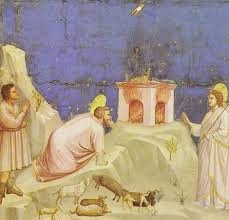
Joachim's sacrifice

Hi all

I love art - doing it and looking at it - so having experienced a Renaissance Festival, watched TV programmes on Medieval English Embroidery and Luxury in the Medieval times, and made Medieval Oatcakes, I thought it was high time that I did a listening exercise on Medieval Art!

I found this fantastic presentation about Medieval and Byzantine art. I found it very entertaining and informative and hope you do too.

Here is the link Medieval and Byzantine Art  and the questions are below:

1 The first Empire that is described is the ............................ Empire.

2 Who was the ruler who had to decide the "thorny question"* of succession?

3 Who did he give it to and in which year?

4 What did each part become known as and what languages did they speak?

5 Which groups of people invaded the Western Empire and how many years did the Empire survive after Theodosius's death?

6 How long did the Byzantine Empire last?

7 What unified the empires?

8 Based on a strict interpretation of the 10 commandments, what did Leo III decree in 730 AD?

9 What was Pope Gregory II's reaction to this?

10 As a result of having more creative freedom, what did Western artists produce and how was it different from the Byzantine artists who were allowed to produce art eventually?

Some of the vocabulary used in this recording is explained below:

*a thorny question - a question that is painfully controversial

To come down to - to result in

to break up - this is a multi-word verb with several meanings but here it means to destroy.

"Caught in the act" - found doing something which is not allowed


a scoundrel - a person who is disreputable, a rogue, a villain


Check your understanding (http://www.thefreedictionary.com):

Vandalism comes from the Vandals who invaded Western Europe. Nowadays, it refers to wilful or malicious destruction of public or private property.

Iconoclasm is the practice of destroying images, particularly of a religious nature.

Iconoclast is a person who destroys sacred images or seeks to overthrow popular beliefs, traditions or institutions.


That's all for today but drop by for the answers 


Wednesday, 18 September 2013

Baird's tapir answers - at last!

Aaagh! I am so late with the answers to the last quiz!

My excuses....the crazy end of semester report and exam marking took over and then suddenly it was the summer.....!

Here are the long-awaited answers to the Baird's Tapir:

1 How long has the tapir been around (on the Earth)?

35,000,000 years

2 For which country is it the official national animal and where is this country?

Belize. It is between Mexico and Guatamala.

3 What is its other name in the country above and what other animals is it actually related to?

Mountain Cow. It is actually related to the horse and rhinoceros.

4 How many toes does it have? How many on each foot?

 14 in total - 4 on each front foot and 3 on each rear foot.

5 How is its nose described and what is it perfect for?

Its nose is rubbery and flexible. It is perfect for eating leaves and aquatic vegetation.

6 What is the maximum it can weigh?

700 pounds (lbs)

7 What is happening to the population of tapirs and why?

Their numbers are dwindling and they are now endangered because their habitats are disappearing.

8 Why is it called Baird's Tapir? 

 It was discovered by a naturalist called Baird in 1843.


Normal service has been resumed! More new posts will be coming along regularly from now on.

Tuesday, 26 March 2013

Baird's Tapir

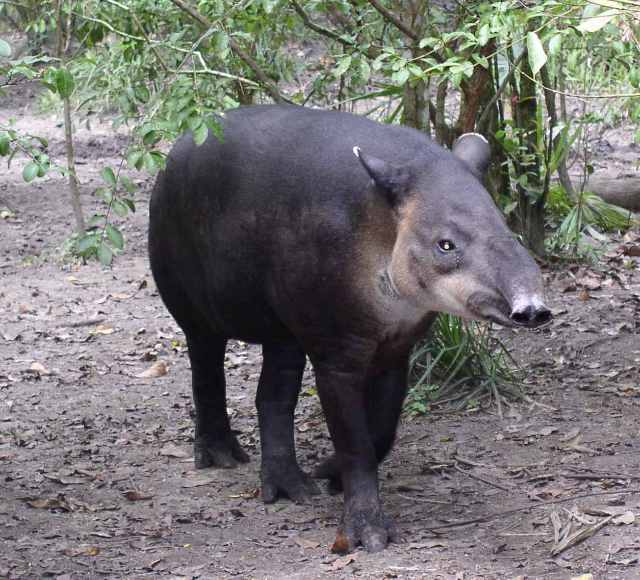
Baird's Tapir


The tapir is a strange animal and definitely worth an entry on the blog. I hope you enjoy it!

The Tapir

This is an easy video clip which gives 8 facts about the Baird's Tapir so all you need to do is listen and write down the facts as you hear them.

1 How long has the tapir been around (on the Earth)?

2 For which country is it the official national animal and where is this country?

3 What is its other name in the country above and what other animals is it actually related to?

4 How many toes does it have? How many on each foot?

5 How is its nose described and what is it perfect for?

6 What is the maximum it can weigh?

7 What is happening to the population of tapirs and why?

8 Why is it called Baird's Tapir?


That was a quick one for today.

Sunday, 24 March 2013

SmartWater answers

 Here are the answers to the SmartWater post:

Which area in the US is the first to use SmartWater to fight crime? Southwater

What difficulties did the British ex-Police Officer talk about with regard to bringing criminals to court? When he was a police officer, he knew who his criminals were but if he didn't have enough evidence, he couldn't bring them to court.

What happens when a person breaks into a business that is protected by SmartWater? They get showered with SmartWater.

If that person is caught, what does the police officer do to show the effects of Smartwater CSI? He uses a blue light to show up the the speckles of green on the person's clothing.

How do they know if that particular person committed the crime they are investigating? Each droplet can be linked to one location only and no other.

How can SmartWater be used in the home? It can be used to mark valuable possessions.

Is Fort Lauderdale enthusiastic about using SmartWater? Yes. They have embraced the idea with gusto (lots of enthusiasm).

What is going to happen in the neighbourhood of South Middle River? Residents are going to receive kits to mark valuable possessions.

How is it going to be financed? Money from a Trust Fund will be used to pay for the kits.

"We're going to roll it out in Fort Lauderdale..." Can you explain this sentence? To roll something out is to introduce it gradually in a planned way. So this sentence means that they have a plan to gradually introduce Smartwater across Fort Lauderdale.

Give 3 synonyms of  "criminals" and which were mentioned in the commentary. Robbers, crooks, burglars.

More posts coming - remember to subscribe!!

Thursday, 14 March 2013

Smartwater to fight crime


This came up on the news today so any plans I had for another post got pushed to one side as I thought this was such a simple yet effective idea and I wanted to share it with you.

It's the use of coded water to catch criminals after a crime has been committed - watch the video to find out more and answer the questions below!

Here is a link to a Fox news report about it:

SmartWater CSI 


Which area in the US is the first to use SmartWater to fight crime?

What difficulties did the British ex-Police Officer talk about with regard to bringing criminals to court?

What happens when a person breaks into a business that is protected by SmartWater?

If that person is caught, what does the police officer do to show the effects of Smartwater CSI?

How do they know if that particular person committed the crime they are investigating?

How can SmartWater be used in the home?

Is Fort Lauderdale enthusiastic about using SmartWater?

What is going to happen in the neighbourhood of South Middle River?

How is it going to be financed?

"We're going to roll it out in Fort Lauderdale..." Can you explain this sentence?

Give 3 synonyms of  "criminals" and which were mentioned in the commentary.


There you go - a quick listening exercise that includes some useful vocabulary.

And one more thing...........If you decide to follow my G+ group, then PLEASE say hello and who you are when you add me as it would be nice to hear from you - at least that way I know you are really human and not computer generated!

Thanks and Byeeeeeeee!


Tuesday, 12 March 2013

Answers to the Extreme Engineering post

Oops - a little later than I wanted but here are the answers to the last post and keep looking for more posts at the end of the week!

Answers to the Extreme Engineering post

Questions

What kind of technology holds the promise for a transatlantic train system? Maglev train technology

How fast might these trains travel? 5000 mph

What problem needs to be solved? Air resistance.

What happens as you travel faster? How much power would the trains use if they travel in a vacuum? The same amount of power as a train travelling at 200 or 300mph outside the vacuum.

When was vacuum tube technology invented? A century ago.

What was it used for? It was used in factories and offices to send small objects and documents around.

How does it work and what happens to objects placed in the tube? Air is pumped of a tube to create a vacuum. With no air, there's no air resistance to any object going through it. If an object is given a push, it goes into the equivalent of instant freefall and is literally sucked through the tube.

Where are engineers currently doing experiments on vacuum tube technology and Maglev trains? MIT

Can you describe the experiments they are doing and what happens to the speed of the train when it is in a vacuum? A miniature maglev train is placed in a tube that represents the transatlantic tunnel. Smoke is added to show the presence of air. The train slides slowly. Next all the air is removed with a vacuum pump. Now, when the train is added, its speed is tripled. Without air to push it back, the train slides completely unimpeded through the tube.

How long is the experimental tube and how long is the proposed transatlantic tunnel? It is 6 feet long and the transatlantic tunnel would be 3000 miles long.

Does the narrator think the experimental tube can easily become reality? He says, "Of course, removing the air from a 6 foot tube is one thing. Turning a 3000 mile long train tunnel into a vacuum is quite another matter." This implies that he thinks it will be difficult to make it become reality.

Hope you managed to get all those long answers! Send feedback below - I would love to hear from you!!


Saturday, 9 March 2013

Extreme engineering and air resistance

Highlands of Scotland - Steam Train


How would you like to be able to travel between Europe and the USA, under the sea but at super high speed?

Apart from the obvious benefit of getting to your destination really quickly, it is possibly a greener solution to the current modes of transport.

The video today looks at how this could become a reality! It's full of science vocabulary to help with those science listenings and readings in the TOEFL!It is not too difficult and is just a short one so it won't take too long!

Here is the link: Air resistance


Vocabulary

To hurtle - to go at a very high speed. 

To do away with - to eliminate

Airless - without air

To shove - to push hard

To impede - to put obstacles in the way

Questions

What kind of technology holds the promise for a transatlantic train system?

How fast might these trains travel?

What problem needs to be solved?

What happens as you travel faster?

How much power would the trains use if they travel in a vacuum?

When was vacuum tube technology invented?

What was it used for?

How does it work and what happens to objects placed in the tube?

Where are engineers currently doing experiments on vacuum tube technology and Maglev trains?

Can you describe the experiments they are doing and what happens to the speed of the train when it is in a vacuum?

How long is the experimental tube and how long is the proposed transatlantic tunnel? 

Does the narrator think the experimental tube can easily become reality?


As I was doing this I wondered about the G-forces on people in the train....wouldn't they have an effect? I am sure someone out there can answer that! 


Remember to subscribe for more updates using the button on the right of the screen. 

Look out for my sister blog starting for younger people and have a nice day!!!


Link to the answers for Extreme Engineering


Answers to Steampunk

Well, it looks like people enjoyed the Steampunk post! Here are the answers to the questions....

Questions for the Introduction and Steampunk Craft

How is the world of Steampunk described right now? It's growing, it's hit a tipping point, it's mainstream.

In what way is it not purely Victorian? It's kind of Victorian but yet it's futuristic as you have these futuristic steam-powered contraptions.

What different elements create the world of Steampunk? Art installations, movement and performance.

What influence did the Industrial Revolution have? It made us forget how to make things with our hands. Steampunk is a world that never happened and has an alternate timeline to the development of the world after the Industrial Revolution.

What two kinds of power are combined in Steampunk? Steam and electrical Tesla power.

What does the narrator (Joey aka Mr Grymm) like to do with antiques? He likes to refurbish them or repurpose them if they can't be mended.


Questions for Steampunk Music

What inspired the narrator to start writing pieces of music about Steampunk? He visited a friend's house and saw Steampunk things lying around.

What connections did he make with the instruments? The instruments like the French horn and bassoon have complicated plumbing which looks very like steampunk design. The contrabassoon has crazy metal valves and tubing that in a Steampunk scenario, really fits the bill.

What is he aiming to do with this style of music? He is trying to make sense of the richness of the world to take the listener beyond the mundane things of day to day life.


Questions for Steampunk Theatre

Is Steampunk true to a particular period in time? No, it is not true to any particular period although it drifts towards the Edwardian era.

What does Steampunk give the performers? They have the freedom to create a new kind of space.

Is the performance a happy one? No, it's sinister.

Can you say why there are two Alices? There are 2 Alices because they are telling the story of a personality pulled hard in 2 directions with 2 conflicting sets of desires.

Questions for the Steampunk Haunted House

What is the aim of the "nightmarescape"? They were interested in the idea of "what is a nightmare", how could they make it contemporary and would people enjoy watching the performance.

Steampunk gave them the inspiration to do what? A lot of our work has to do with the collusion of disparate elements which might not otherwise be contiguous and putting them together to create new meaning.


Final section

What does Joey hope Steampunk will give artists and how does he view the future of Steampunk? He hopes that it will get artists to think more about their resources and what we are doing with our history, our yesterday and our memories. He thinks there is a lot out there and it (Steampunk) is growing

A new post about Extreme Engineering is going up today so check it out!


And for younger people, I have created your own blog so I will put something up for you in the next few days.

Wednesday, 6 March 2013

Steampunk

Steampunk inspired

Hey everyone!!

Prepare to enter the world of  
STEAMPUNK!


I love this style and although maybe it's not something to turn up to work in, I find the concept so fascinating that I thought it would be a good one to do a listening/vocabulary exercise on as it fits into the category of Arts.

The video clip I have found has a wealth of fantastic vocabulary and different accents so it will really test your listening abilities - I hope you enjoy finding out about a subject that could be new to some of you too!

The video is in sections so if you want, you can listen to a section then answer the questions before moving on.......It is not the easiest video I have posted but I hope you enjoy the challenge!

Here is the link to the video clip: Steampunk

Introduction and Steampunk Craft
Vocabulary

to hit a tipping point - to reach a stage when things start to change and gather momentum

the mainstream - the accepted normal, dominant course or trend in society

contraptions - a mechanical device or invention that is unnecessarily complicated, strange or improvised

electrical Tesla power - Nikola Tesla lived from 1856 - 1943 and is considered to be one of the most important contributeurs to electrical inventions.

refurbish - to renovate anything that is worn out and in need of repair

repurpose - to give something a new use or purpose.

Questions for the Introduction and Steampunk Craft

How is the world of Steampunk described right now? It's g....................., it's h..... a t.................. p............, it's m............................

In what way is it not purely Victorian?

What different elements create the world of Steampunk?

What influence did the Industrial Revolution have?

What two kinds of power are combined in Steampunk?

What does the narrator (Joey aka Mr Grymm) like to do with antiques?

Steampunk Music
 Vocabulary
scrap metal - unused pieces of metal

French Horn, Bassoon and Contra-Bassoon - wind instruments

valves - a device that alters the flow of air, liquid or gas

tubing - a long, hollow, usually cylindrical object for conveying air, liquids or gases.

to fit the bill (idiom) - to be a perfect match

Questions for Steampunk Music

What inspired the narrator to start writing pieces of music about Steampunk?

What connections did he make with the instruments?

What is he aiming to do with this style of music?


Steampunk Theatre
Vocabulary
an aesthetic - an artform

to drift - to tend to move in slow, unplanned way

the period - the era or point in time

sinister - evil and frightening

to be torn asunder - to be broken apart

Questions for Steampunk Theatre

Is Steampunk true to a particular period in time?

What does Steampunk give the performers?

Is the performance a happy one?

Can you say why there are two Alices?

Steampunk Haunted House
Vocabulary

a nightmarescape - this is not really a word but it can be understood from "nightmare" and "landscape". A nightmare is a very bad dream and a landscape is a panoramic view or scene. So together, a "nightmarescape" must be a very bad, dreamlike scene.

"..have them dig it!" - get them to really like something and appreciate it

to resonate - to understand and empathise with

collusion - a bringing together

disparate - different, distinct kinds, dissimilar

contiguous - touching or in close proximity

Questions for  Steampunk Haunted House

What is the aim of the "nightmarescape"?

Steampunk gave them the inspiration to do what? A lot of our work has to do with the c................ of d................... ................which might not otherwise be ............................ and putting ................ .................... to ....................... .................... .........................

Final section

What does Joey hope Steampunk will give artists and how does he view the future of Steampunk?

Finished? You did it all? You want more?!!!


Here are the answers to the questions above.

If this has got you interested to see more then here are some links to trailers to films that you could argue are Steampunk inspired, the first one being an old back and white movie!

The Fabulous World of Jules Verne

Dune

Steamboy

The final link is to a great, little short film made on a small budget over about 3.5 years. Go and get a coffee, put your feet up and enjoy it!

Aurora

Bye for now!


Bletchley Park and codebreaking

Husbands, sons and boyfriends are impossible to buy presents for but I had a brainwave when I was thinking of a present for my husband th...